


 Python


Aim:
The aim of this project is to propose an efficient, real-time system for automatic classification of coffee bean defects using the YOLOv8 deep learning model.
Abstract:
The coffee industry relies heavily on accurate coffee bean classification to maintain quality and profitability. Traditional methods of manual inspection are slow, subjective, and error-prone. This project proposes a deep learning-based classification system using the YOLOv8 model to achieve higher accuracy and faster processing. The proposed system leverages image processing, data augmentation, and cloud integration for real-time, scalable, and cost-effective coffee bean classification. The mobile application aims to support real-time classification, enabling users to assess coffee bean quality remotely, improving productivity and quality control. The cloud-based approach allows for seamless data transmission and low-latency classification, making it suitable for a wide range of coffee production environments.
Introduction:
Manual classification of coffee beans is labor-intensive, prone to human error, and not scalable for large production environments. While some automated systems exist, they require costly hardware and offer limited functionality. To address these challenges, this project proposes an AI-driven, cloud-enabled system that utilizes YOLOv8 for real-time, accurate, and scalable classification of coffee bean defects. By enabling remote access to quality control tools, this system is expected to provide coffee producers, traders, and warehouses with a practical solution for quality control, ensuring consistent product quality and increased operational efficiency. The mobile app’s integration aims to allow users to classify beans on-site, significantly reducing the time required for defect identification and classification.
Existing System:
Current methods rely on manual inspection or limited image recognition systems. Manual methods are slow, error-prone, and inefficient, especially in large-scale production. Existing automated solutions are often hardware-dependent and not scalable, making them unsuitable for remote farms or large warehouses. The manual process involves visual inspection by human operators, leading to subjective decisions and inconsistency in results. Automated systems currently in use are restricted to fixed environments and are not adaptable to real-time classification. These limitations highlight the need for an accessible, automated, and accurate classification system that can be used remotely and on-site.
Disadvantages of Existing System:
- Manual methods are slow, subjective, and inconsistent.
- Automated systems often require costly hardware.
- Limited scalability and adaptability for real-time classification.
Proposed System:
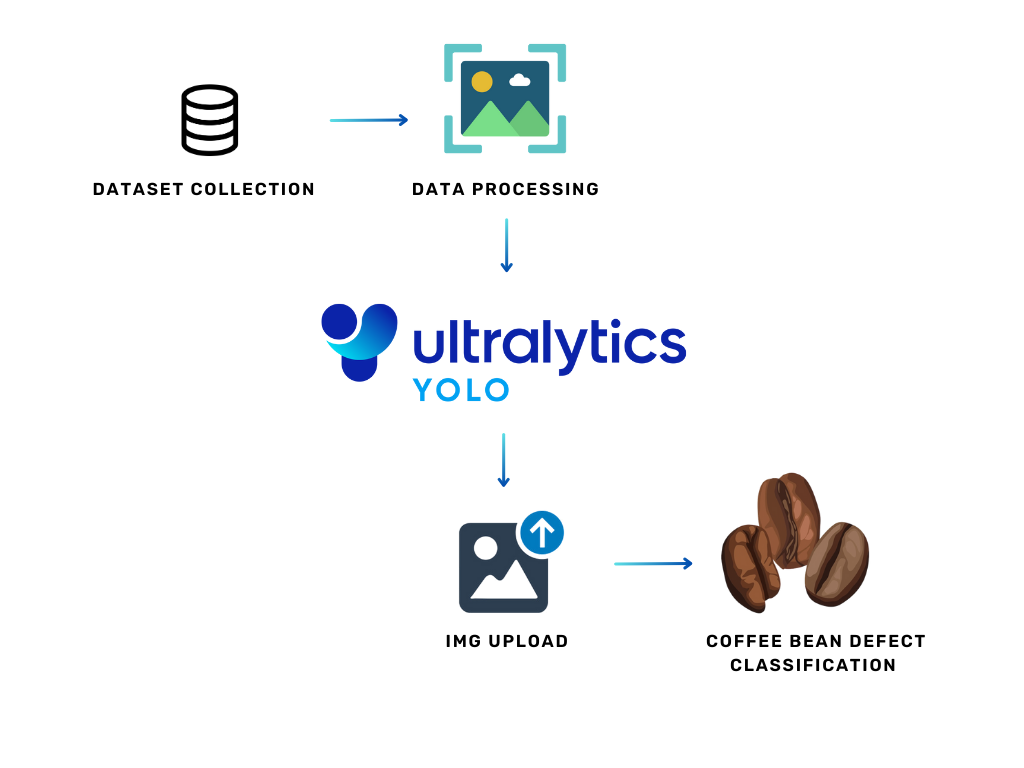
The proposed system aims to leverage YOLOv8 for efficient classification of coffee bean defects. The design involves training on a robust dataset with data augmentation and cloud integration. The system is composed of three key modules:
- Dataset Collection: Images of coffee beans are to be collected, annotated, and divided into training, validation, and testing sets. This ensures that the model learns to recognize and classify various types of defects accurately.
- YOLOv8 Model: The YOLOv8 model will be trained to detect and classify coffee bean defects in real-time. Its architecture enables one-pass processing, ensuring fast and efficient classification.
- Cloud-Based Real-Time Classification: The system will be integrated with a mobile app for real-time quality assessments using cloud technology, supporting remote use. The app will allow users to upload images of coffee beans and receive immediate results, making the system suitable for use in farms, processing units, and warehouses.




Reviews
There are no reviews yet.