


 Python


Aim:
The aim to build an AI system that helps traders make better decisions during unpredictable and high-volatility market periods. To automate chart reading and reduce human error by using AI to analyze patterns and market behavior. It create a smarter trading assistant that can learn from past results and provide more reliable buy/sell guidance.
Abstract:
This project develops an AI-based trading assistant designed to improve decision-making in volatile markets. It analyzes price charts using visual AI and studies market conditions using adaptive volatility calculations. The system then generates trading suggestions with the help of a language model. It also learns from previous outcomes to improve future decisions. Overall, the project aims to provide a safer, more reliable way to the trade futures automatically.
Proposed System:
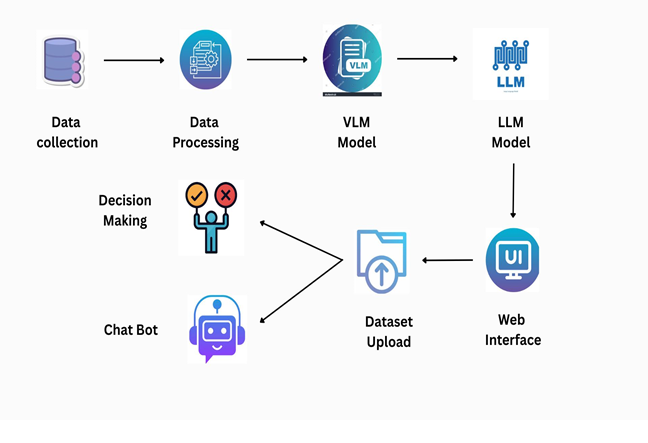
The proposed system introduces an AI-driven trading framework that integrates AFAVR, an adaptive volatility model using dynamic ATR windowing, to identify high-volatility phases with greater accuracy. It generates multiscale candlestick charts (monthly, weekly, daily) and analyzes them using a Vision-Language Model (VLM) for pattern recognition and trend interpretation. These visual insights are combined with market indicators to provide a blended quant-visual signal. A Language Model (LLM) then performs decision fusion, evaluating both indicator-based signals and VLM interpretations to produce buy, sell, or hold decisions. The trading engine uses adaptive ATR-based stop-loss and take-profit levels that adjust according to volatility regimes. Position sizing is dynamically computed using risk percentage, ATR distance, and volatility classification. A reinforcement memory buffer stores past trade outcomes, helping the LLM improve decision stability over time. The entire system automates signal generation, trade execution logic, and performance evaluation for more consistent trading in volatile markets.
Advantage:
- The system adapts to market volatility using dynamic ATR windows, unlike traditional fixed-indicator approaches.
- VLM-based candlestick interpretation introduces automated visual pattern recognition, reducing subjective manual analysis.
- LLM decision fusion combines visual insight and numerical indicators, improving accuracy across market regimes.
- Reinforcement-based memory allows the system to learn from outcomes, enhancing reliability over time—something existing tools lack.


Reviews
There are no reviews yet.