


 Python


Aim:
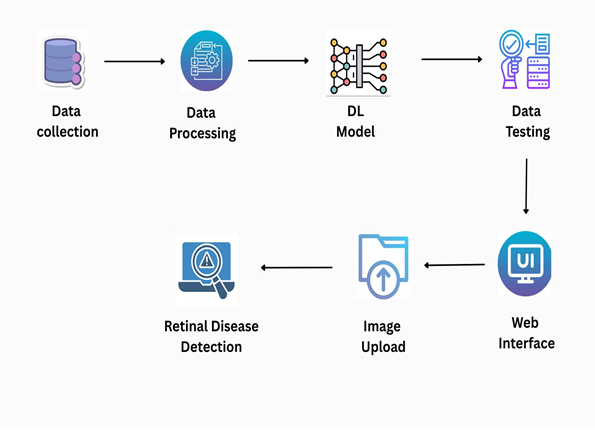
Aim to build a reliable system that can identify different retinal diseases from OCT images. To create a practical workflow that can analyze images, compare predictions, and flag mistakes for improvement. It combine the strengths of multiple models so the final decision is more accurate and stable.
Abstract:
This project develops a system that learns to recognize several retinal diseases from eye scan images. Instead of depending on a single model, it uses multiple models and merges their decisions for stronger accuracy. The system tests each model, compares their strengths, and chooses the most confident overall result. It also analyzes where models fail so the system can be improved over time. The outcome is a dependable screening tool that supports faster and more consistent eye-disease detection.
Proposed System:
The proposed system integrates three complementary architectures—ResNet50, EfficientNet-Lite, and Swin Transformer—to capture both local and global OCT features. Each model is individually trained with optimized learning rates, schedulers, and early stopping to ensure stable convergence. The framework performs independent evaluation for each network, generating accuracy, reports, and confusion matrices. A majority-vote ensemble merges model outputs, significantly reducing single-model bias and improving prediction reliability. The system also performs automated inference, annotates predictions on images, and organizes outputs into structured folders. A dedicated module logs misclassified samples into CSV, enabling targeted error analysis and dataset refinement. This results in a full end-to-end pipeline that handles training, evaluation, ensemble decision-making, and deployment-ready inference.
Advantage:
- This approach combines diverse feature extractors, delivering higher accuracy and robustness than any single model.
- Automated misprediction tracking enables deeper insight into failure cases, which traditional systems often ignore.
- It provides a more reliable, generalizable, and error-resistant solution for multi-class OCT disease classification.




Reviews
There are no reviews yet.