


 Python


Aim:
The main aim of this project is to design and develop a Wearable Life Jacket for Aquatic environment for hypothermia with Cloud interface.
Abstract:
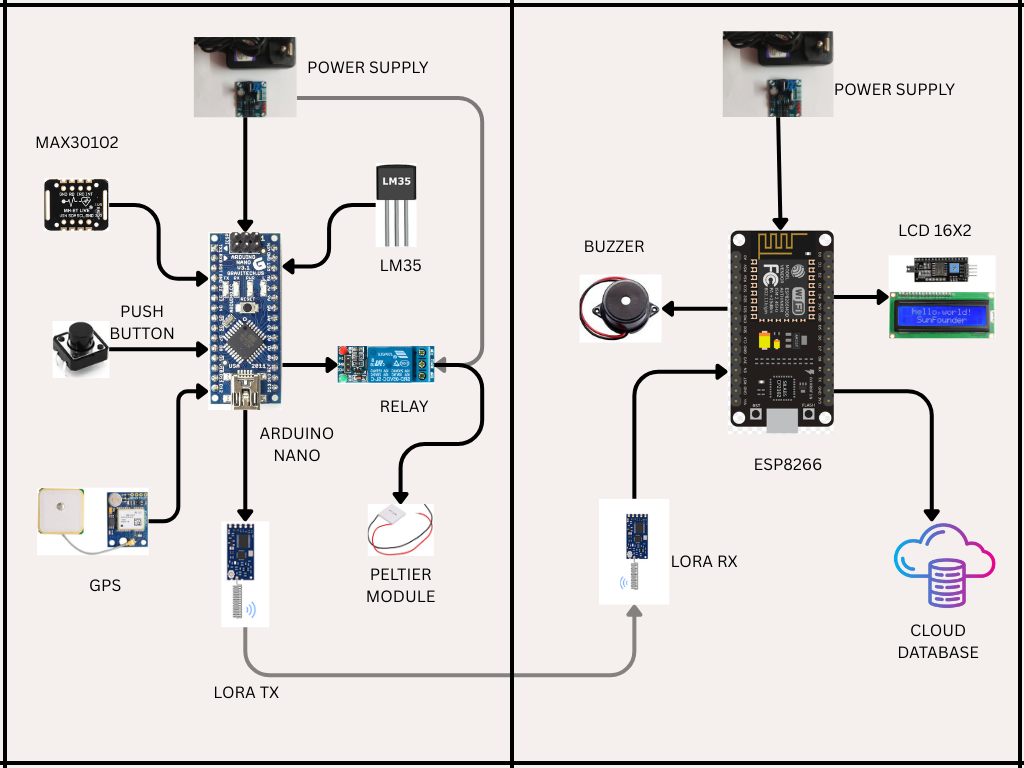
The “Wearable IoT Life Jacket” utilizes advanced technology to enhance safety in aquatic environments, addressing the critical threat of hypothermia. This innovative system integrates two Arduino Nano boards, a heart rate sensor, temperature sensor, GPS module, Peltier module, and LoRa communication technology. The transmitter side collects vital data, including heart rate and body temperature, and communicates this information over long distances using LoRa. In response to low temperature readings, the Peltier module activates to heat the jacket, combating hypothermia. An emergency push button allows the wearer to send their location to the receiver when pressed, ensuring rapid assistance. The receiver features an LCD display that shows real-time health metrics and alerts, supported by a buzzer for immediate notifications. By combining these technologies, the wearable life jacket offers a proactive solution for monitoring vital signs and providing location tracking, ultimately improving survival rates in emergency situations on water.
Proposed Method:
The proposed method involves developing an advanced “Wearable IoT Life Jacket” that integrates multiple sensors and communication technologies to enhance safety and emergency response in aquatic environments. The system utilizes two Arduino Nano boards: one configured as the transmitter and the other as the receiver. On the transmitter side, sensors such as a heart rate monitor and temperature sensor continuously collect vital data from the wearer. The GPS module tracks the wearer’s location, which is crucial for emergency rescues. This information is transmitted wirelessly over long distances using LoRa technology, ensuring reliable communication even in remote areas. In scenarios where the temperature falls below a predefined threshold, the Peltier module is activated to heat the jacket, helping to prevent hypothermia. The emergency push button allows the wearer to send an immediate alert, transmitting their GPS location to the receiver unit. The receiver, equipped with ESP8266, features an LCD display that presents real-time metrics such as heart rate, body temperature, and location data, accompanied by a buzzer for audible alerts and also updates them to the cloud. This comprehensive approach not only improves individual safety but also facilitates timely assistance, significantly enhancing survival rates in critical situations on the water.


Reviews
There are no reviews yet.