


 Python


Aim:
To develop a predictive model for early detection of childhood malnutrition using survey-based health and nutrition data, and to compare the performance of ensemble and classical machine learning algorithms.
Abstract:
Childhood malnutrition continues to be a pressing global health issue, particularly in developing countries where healthcare resources are limited. Traditional detection methods rely heavily on anthropometric measurements, which often fail to capture hidden risk factors. In this project, we propose a machine learning-based framework that leverages publicly available Kaggle survey datasets to predict malnutrition risk. The collected dataset is preprocessed and balanced using the Synthetic Minority Over-sampling Technique (SMOTE) to overcome class imbalance. Four machine learning models—Light Gradient Boosting Machine (LGBM), CatBoost, Logistic Regression, and Random Forest—are trained and evaluated. Among these, the model achieving the highest accuracy is integrated into a user-friendly interface for prediction. The proposed system demonstrates the potential of machine learning in assisting healthcare workers with early detection and decision-making, thereby enabling timely interventions and improved child health outcomes
Proposed System:
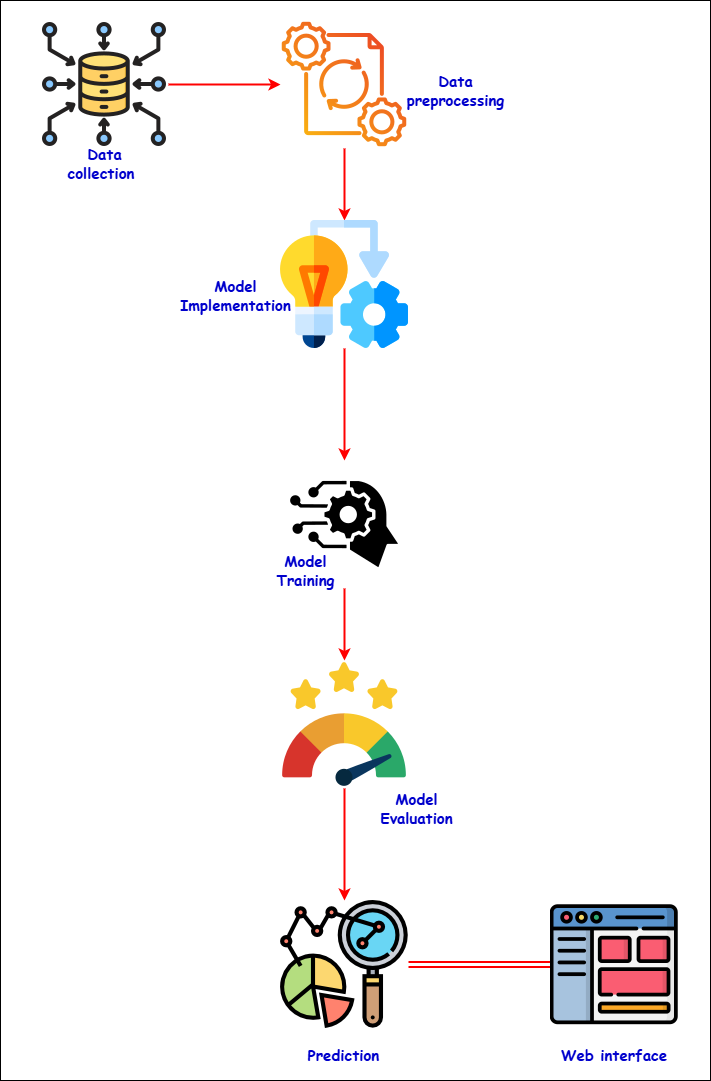
The proposed system is designed to build an accurate and automated prediction model for childhood malnutrition. It begins with collecting survey datasets from Kaggle, which contain multiple health and nutrition-related features. The raw data undergoes preprocessing, including cleaning missing values, encoding categorical attributes, and normalization. To address the critical issue of class imbalance—where moderate and severe malnutrition cases are under-represented—Synthetic Minority Oversampling Technique (SMOTE) is applied to generate synthetic samples. After balancing, the dataset is used to train and evaluate four machine learning models: LightGBM, CatBoost, Logistic Regression, and Random Forest. The comparative analysis identifies the best-performing model, which is then integrated into a user-friendly prediction interface. The system ultimately classifies children into three categories: moderate (0), normal (1), and severe (2) malnutrition, thereby assisting healthcare providers in early and effective decision-making.
Advantage:
- Early and accurate prediction of malnutrition risk
- Handles high-dimensional and categorical survey data effectively
- Ensemble models improve robustness and generalization
- Helps healthcare workers prioritize interventions


Reviews
There are no reviews yet.