


 Python
Aim:
The mainstay of the project is to design and implement a wireless sensor network using ESP32 nodes for real-time environmental monitoring.
Introduction:
In today’s world, rapid urbanization, industrialization, and population growth have contributed significantly to environmental degradation, particularly in terms of air quality and pollution. The rise in harmful gases, particulate matter, and fluctuating climatic conditions poses severe risks not only to the ecosystem but also to human health and overall well-being. Prolonged exposure to polluted environments can lead to respiratory diseases, allergies, cardiovascular problems, and even long-term chronic illnesses. The World Health Organization has consistently emphasized that poor air quality is one of the leading causes of premature deaths globally. Beyond health, environmental issues also affect agriculture, biodiversity, and the overall sustainability of urban life. Communities, governments, and organizations are increasingly recognizing the importance of continuous monitoring of environmental parameters to ensure safer living conditions and timely policy interventions. Traditional monitoring methods are often costly, centralized, and limited in coverage, which restricts their effectiveness in addressing real-time environmental challenges. Thus, there is a growing demand for affordable, decentralized, and scalable solutions that can monitor air quality and other environmental factors at multiple points simultaneously. This shift towards smart and technology-driven monitoring can empower society to make informed decisions, promote sustainable practices, and enhance public health and safety.
Proposed system:
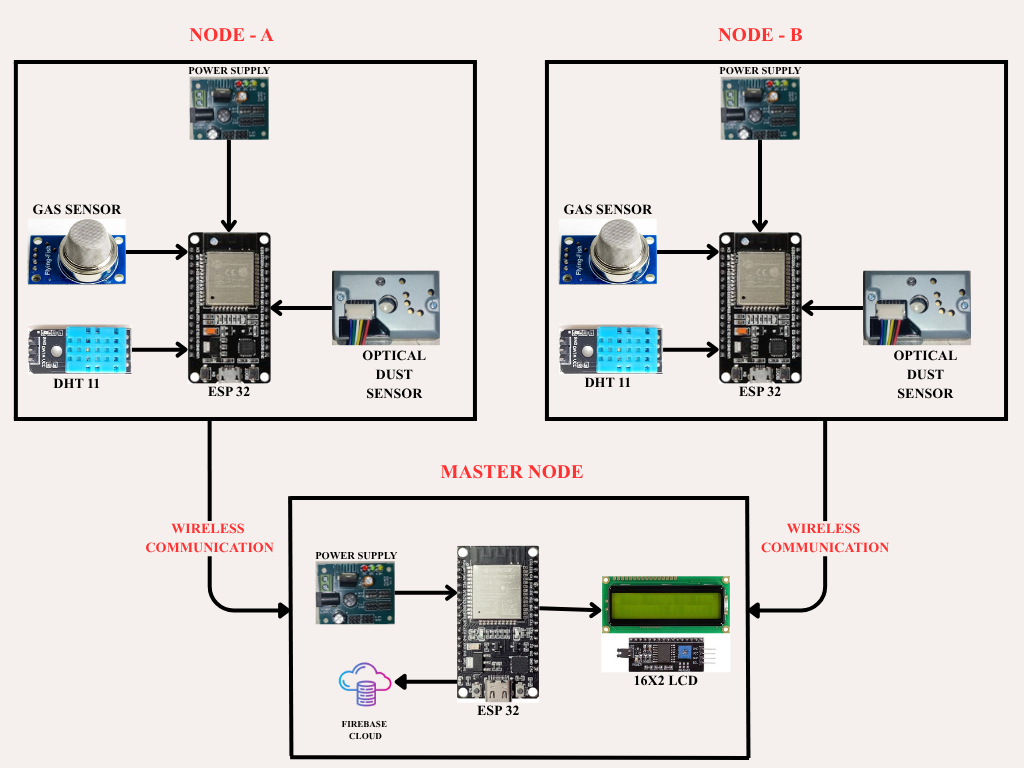
The proposed system introduces a wireless sensor network (WSN) using three ESP32 microcontrollers, where one acts as the master node and two act as slave nodes. Each node is equipped with a DHT11 sensor for temperature and humidity measurement, a gas sensor for detecting harmful gases, and a dust sensor for monitoring particulate matter levels (PM2.5 and PM10). The slave nodes are responsible for collecting localized environmental data and transmitting it to the master node using the ESP-NOW peer-to-peer communication protocol. This ensures efficient, low-power, and network-independent data transfer between nodes, eliminating the need for Wi-Fi in intra-network communication.
The master ESP32 functions as a central hub, receiving sensor readings from the two slave nodes. After processing and compiling the data, the master node establishes a Wi-Fi connection to upload the environmental information to a cloud platform, where it can be analyzed, visualized, and accessed remotely. This setup enables real-time monitoring of air quality and environmental conditions across multiple points simultaneously. The system is designed to be low-cost, scalable, and reliable, making it suitable for applications such as smart cities, pollution monitoring, industrial safety, and public health management.



Reviews
There are no reviews yet.